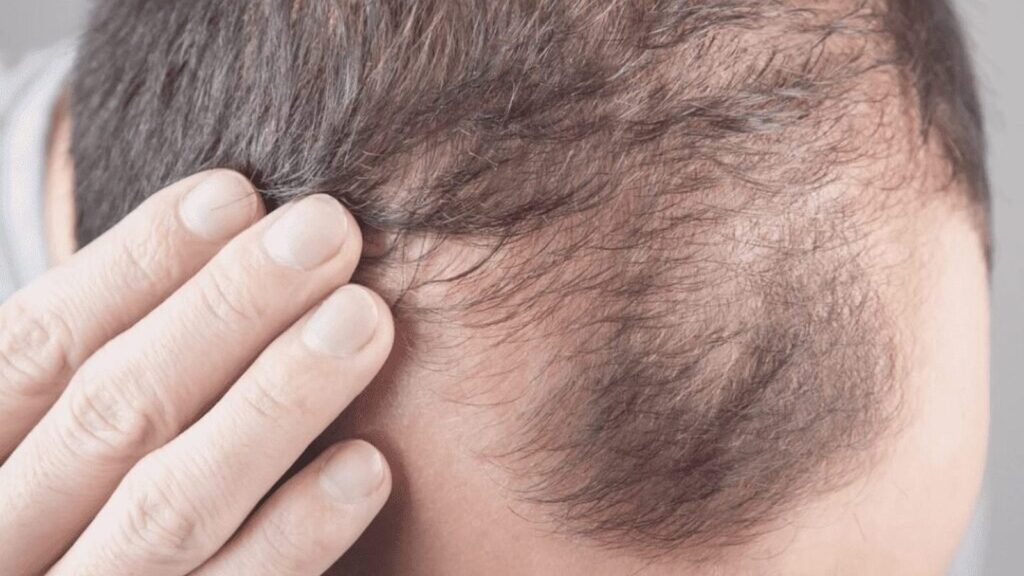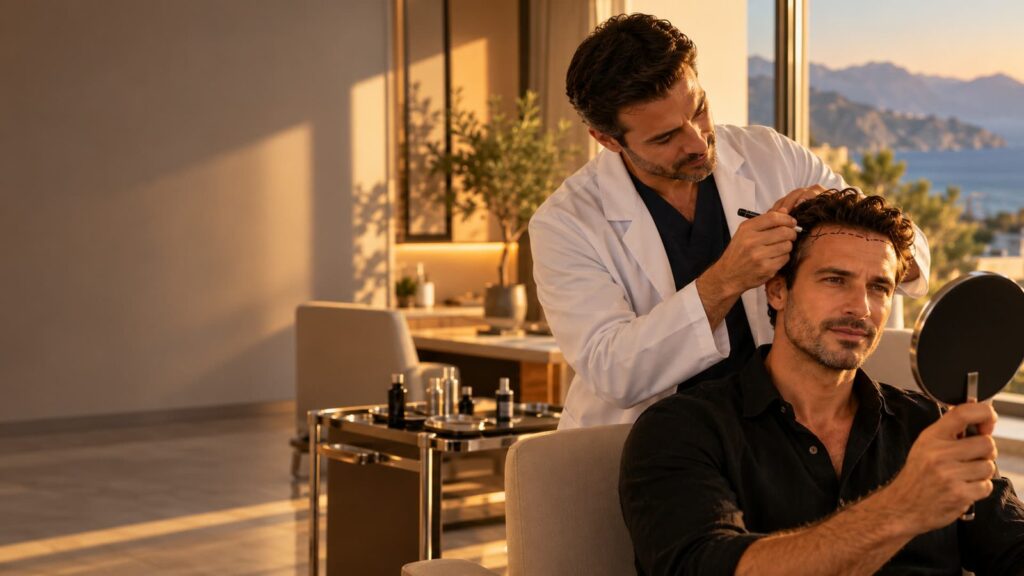
Most people fly home two or three days after a hair transplant and go back to desk work after about a week. Crusts fall away within about 10 days, the transplanted hairs shed between weeks 2 and 6, new growth starts around months 3 to 4, and most of the result shows at 12 months, maturing up to 18.
Key takeaways
- Your trip runs over three days: consultation and hairline drawing on day 1, the procedure on day 2, then a check-up, your first wash and the flight home on day 3.
- Desk work is usually fine after about a week. Redness and crusts are the visible signs, and the crusts fall away within about 10 days.
- Shedding between weeks 2 and 6 is expected. The roots stay in the scalp and start growing new hair around months 3 to 4.
- Density builds between months 6 and 9. Most of the result is visible at 12 months and keeps maturing up to 18 months.
- Rules on exercise, caps and water exposure differ between surgeons, so follow the written aftercare you are given.
How long does it take to recover from a hair transplant?
There are two recoveries: the skin heals in about 10 days to two weeks, and the hair takes 12 to 18 months to grow in fully. You can be back at a desk long before the result is visible.
The healing stage is short. After follicular unit excision (FUE), the International Society of Hair Restoration Surgery (ISHRS) says tiny scabs form and are usually rubbed away gently 1 to 2 weeks later. The ISHRS also notes that most patients report no more than mild discomfort after surgery. Your package includes medication and painkillers, plus the shampoo and lotion you use at home.
The growth stage takes far longer. Transplanted hair grows at about 1 cm a month, and the ISHRS says it is often a year or more before the full result appears. The timeline below is the one we give every patient. It applies to FUE, Sapphire FUE and DHI, because all three move the same follicles. Only the instrument used to place them changes.
| When | What happens | What you do |
|---|---|---|
| Day 1 | Arrival in Antalya, consultation, and the doctor draws your hairline with you | Agree the plan and ask questions before anything starts |
| Day 2 | The procedure, under local anaesthesia and sedation | Rest at the hotel and follow the written aftercare |
| Day 3 | Check-up and first wash at the clinic | Fly home with your shampoo, lotion and medication |
| Days 4 to 10 | Redness and small crusts; the crusts fall away within about 10 days | Wash gently as shown at the clinic |
| About 1 week | Most people feel ready for desk work | Avoid heavy exertion until your surgeon clears it |
| Weeks 2 to 6 | Transplanted hairs shed | Nothing: the roots stay in place |
| Months 3 to 4 | New growth begins, often fine at first | Send progress photos if your clinic asks for them |
| Months 6 to 9 | Density builds noticeably | Keep up any medication your doctor recommended |
| 12 to 18 months | Most of the result at 12 months, maturing up to 18 | Final review with your doctor |
When can I fly home after a hair transplant?
Our patients fly home on day 3, once the doctor has checked the grafts and the clinic has done the first wash. The direct flight from the UK to Antalya takes about 4 hours, so the journey is not a long-haul one.
The NHS warns that air travel and major surgery both raise the risk of a blood clot. It suggests waiting 5 to 7 days before flying after breast surgery or liposuction, and 7 to 10 days after facial surgery or a tummy tuck. It gives no figure for hair transplants, which are done under local anaesthesia. Still, the trip home deserves a little planning.
- Move on the plane. For journeys of 4 hours or more, the NHS advises loose clothing, plenty of water, no alcohol and walking around when you can.
- Tell the doctor about your history. Mention any previous clot, any blood-thinning medication and any other medical condition before surgery, not at the airport.
- Protect the grafts. Ask before you put a cap, hood or neck pillow anywhere near the treated area, and keep the clinic’s aftercare sheet in your hand luggage.
If you get pain or swelling in one leg after the flight, contact NHS 111 or ask for an urgent GP appointment. If you are short of breath or have chest pain, the NHS says to call 999 or go to A&E.
When can I go back to work?
Most people return to desk work after about a week. Jobs that involve heavy lifting, heat, dust or helmets need a longer gap, and your surgeon should give you a date in writing.
For desk work, the question is often less about how you feel and more about what you are happy for colleagues to see. For the first week to 10 days the recipient area is pink with small crusts, and with a shaved technique the donor area is shaved too. The ISHRS census found that 95% of first-time surgical patients started treatment between 20 and 35, so most patients are fitting recovery around a working life. Common ways to manage it:
- Book the trip so the first week back falls over annual leave or working from home.
- Ask whether an unshaven technique suits you. DHI can be done without shaving, which helps some patients go back to daily life more discreetly. It also comes as unshaven FUE.
- Remember that shedding between weeks 2 and 6 can make your hair look much as it did before surgery for a while. That is normal and temporary.
When can I wash my hair, wear a cap, exercise or drink alcohol?
Your first wash happens at the clinic before you fly. After that you wash gently at home with the shampoo and lotion in your package. Caps, exercise, swimming and alcohol depend on your surgeon’s written instructions.
The ISHRS says rules on exercise, water exposure, bandages and sprays vary among surgeons. An international expert consensus says patients should gradually resume their normal haircare routine and be followed up closely during the first year. So the table shows who decides each step, not one fixed timetable.
| Activity | What to expect | Who decides |
|---|---|---|
| Washing | First wash at the clinic on day 3, then gentle washing at home with the supplied shampoo and lotion until the crusts have gone | The clinic shows you how before you leave |
| Caps and hats | Nothing tight on the grafts in the early days; a loose hat once you are told it is safe | Your surgeon |
| Exercise and the gym | Anything that makes you sweat heavily or strain waits for clearance; ask what light activity is allowed | Your surgeon |
| Sun and swimming | The NHS advises avoiding sun, swimming, alcohol and sightseeing straight after surgery | Your surgeon confirms when to restart |
| Alcohol and smoking | Stop smoking and avoid alcohol before surgery as your doctor advises, and ask when you can restart | Your doctor |
When will I see the final result?
Expect most of the result at 12 months, with hair still thickening and settling up to 18 months. The first new hairs usually appear around months 3 to 4. A clear change in density tends to show between months 6 and 9.
What to expect at each step:
- Weeks 2 to 6: shedding. The hair shafts that were transplanted fall out while the follicles stay put. Some people also lose some of their own nearby hair for a while. The ISHRS calls this unwanted shedding of your original, native hairs. Our guide to shedding and shock loss explains both.
- Months 3 to 4: first growth. New hairs come through, often fine and uneven at first.
- Months 6 to 9: density. Hairs thicken and the shape of the new hairline becomes clear.
- Months 12 to 18: maturing. Most of the result is in place at 12 months. Texture and fullness can keep improving up to 18 months.
Your follow-up covers this whole period: 12 months with the Standard package and 18 months with Premium. The joint UK and Turkish guidelines say the doctor who performed the surgery should assess both the interim progress and the final result. A transplant does not stop your own hair loss from progressing, so ask your doctor whether medication makes sense for you. Our article on finasteride after a hair transplant covers the options and the MHRA warnings.
What is normal, and when should I call the clinic?
Redness, small crusts, mild tenderness and shedding between weeks 2 and 6 are all normal. Call the clinic about spreading redness, pus, worsening pain, a fever, dark patches of skin or lumps that do not settle.
Under the joint UK and Turkish guidelines, clinics should have systems in place to deal with complications during and outside working hours. The guidelines name necrosis (skin death), infection, cysts and dysaesthesia (altered or painful sensation), and expect the clinic to be able to supply antibiotics. That gives you a fair list of what to report.
| Usually normal | Contact the clinic |
|---|---|
| Pink or red skin in the first week or two | Redness that spreads or gets worse after the first few days |
| Small crusts that fall away within about 10 days | Pus, a bad smell or yellow crusting that keeps returning |
| Mild tenderness, eased by the medication provided | Pain that increases instead of settling, or a fever |
| Transplanted hairs shedding at weeks 2 to 6 | Dark, grey or black patches of skin in the recipient area |
| Fine, patchy early growth at months 3 to 4 | Lumps or spots that persist, or sensation that stays abnormal |
UK patients can reach us on WhatsApp at +44 7988 487 251. Send clear photos with your message. For anything that feels like an emergency, use NHS 111 or 999 first and tell the clinic afterwards.
If you have not had surgery yet, a plan starts with four photos on WhatsApp: front, top, crown and back. The doctor reviews them and sends a written plan and price, with no deposit needed to get one. You can also estimate your grafts and price on our home page first.
Frequently asked questions
Is hair transplant recovery painful?
Most people describe discomfort rather than pain. The ISHRS says most patients report no more than mild discomfort after surgery. The procedure is done under local anaesthesia and sedation, and your package includes medication and painkillers for the first days. Pain that gets worse rather than better, or comes with a fever, is a reason to contact the clinic.
When can I wear a hat after a hair transplant?
Not straight away. Nothing should press on or rub the grafts in the first days, so wait until your surgeon says a loose hat is safe, and avoid anything tight. Bring a hat for the sun, but ask before you wear it. Different surgeons give different timings, so follow the written aftercare from your own clinic.
When can I go back to the gym after a hair transplant?
Anything that makes you sweat heavily or strain should wait until your surgeon clears it, and the same goes for swimming. The ISHRS notes that rules on returning to exercise vary among surgeons, so ask for a date in writing before you leave the clinic. Ask about lifting weights and contact sports separately.
Will people notice I have had a hair transplant?
For about the first 10 days, yes, if they look closely: the treated area is pink with small crusts, and a shaved donor area is visible. After the crusts fall away, most people look much as they did before surgery, especially during shedding at weeks 2 to 6. Unshaven DHI or unshaven FUE can make the first fortnight more discreet.
When does new hair start to grow after a transplant?
New hairs usually appear around months 3 to 4 after the procedure, often fine and patchy at first. Density builds noticeably between months 6 and 9, and most of the result is visible at 12 months, with hair still maturing up to 18 months. Your follow-up runs for 12 months with Standard and 18 months with Premium.
Sources
- FUE: what is it?, International Society of Hair Restoration Surgery, undated, accessed 30 October 2026
- Surgical treatments for hair loss, International Society of Hair Restoration Surgery, undated, accessed 30 October 2026
- ISHRS 2025 Practice Census results, International Society of Hair Restoration Surgery, 13 May 2025
- Cosmetic surgery abroad, NHS, reviewed 14 December 2022
- DVT (deep vein thrombosis), NHS, reviewed 30 April 2026
- Vano-Galvan S, et al. An international expert consensus statement focusing on pre and post hair transplantation care. J Dermatolog Treat 2023;34(1):2232065, Journal of Dermatological Treatment (PubMed), 2023
- UK and Turkish medical associations unite to issue minimum guidelines for hair transplant surgery, BAAPS (with BAHRS, BAPRAS and TSPRAS), 13 December 2023
Written by our editorial team and checked against the sources listed, following our editorial policy. Last updated 30 October 2026. This article is general information and does not replace advice from a doctor who has examined you. Medically reviewed by