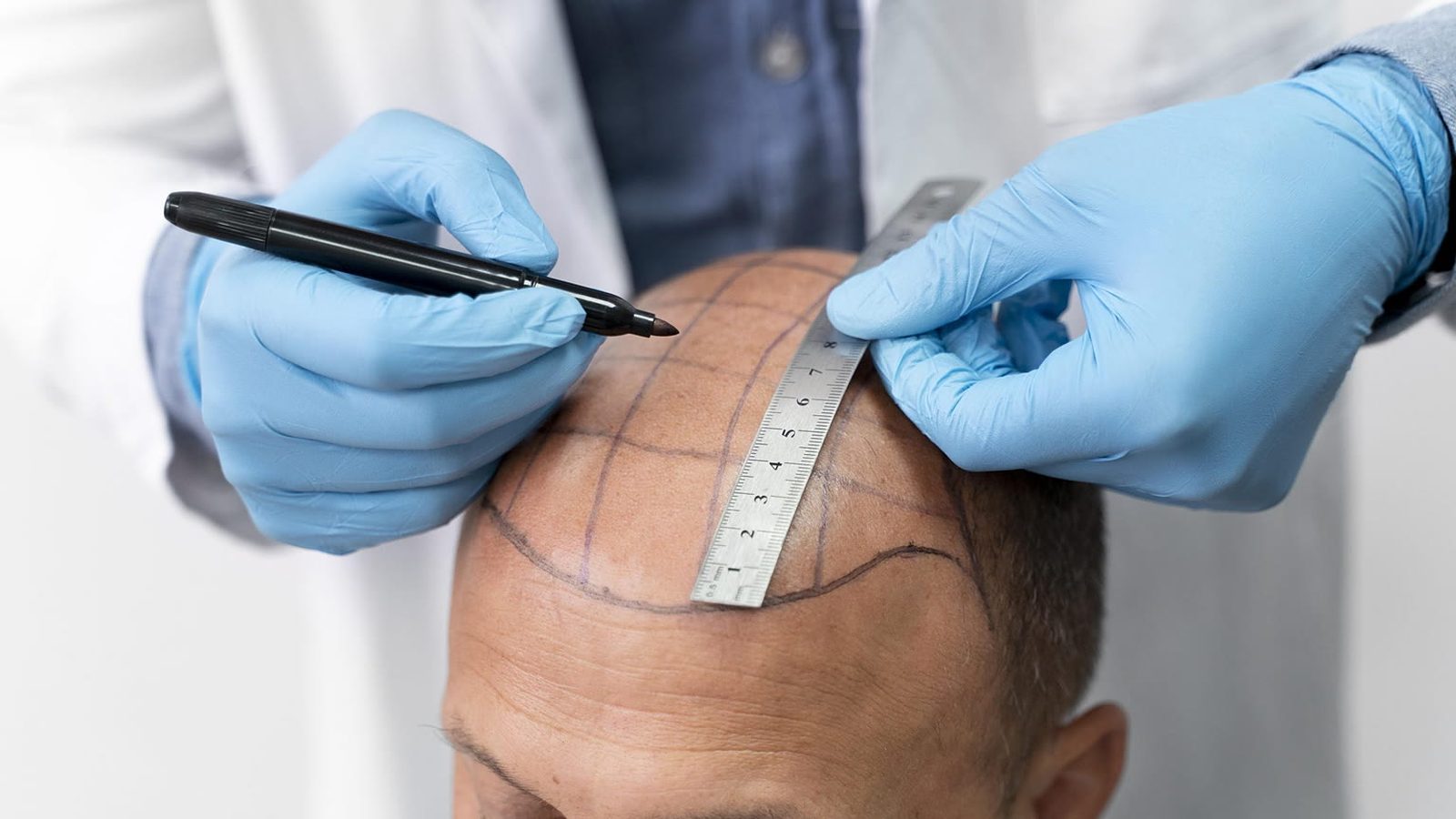
Most men need between 1,000 and 6,000 grafts, depending on their Norwood stage. That means about 1,000 to 1,500 for stage 2, 1,500 to 2,500 for stage 3, and 5,000 to 6,000 for stage 7. The doctor confirms your number from photos, because your donor area sets the real limit.
Key takeaways
- Typical ranges: Norwood 2: 1,000 to 1,500; 3: 1,500 to 2,500; 4: 2,500 to 3,500; 5: 3,000 to 4,500; 6: 4,000 to 5,500; 7: 5,000 to 6,000.
- A graft is a follicular unit, a natural group of usually one to four hairs, so 2,500 grafts carry more than 2,500 hairs.
- Your donor area is finite. How much can be taken safely depends on its density, not on how many grafts you would like.
- Clinics quote different numbers because they count differently, plan different densities or have not examined your donor area.
- Hair loss usually keeps progressing, so a good plan leaves grafts in reserve for the future.
How many grafts do I need for my Norwood stage?
Use your Norwood stage as a starting point. Stage 2 usually needs about 1,000 to 1,500 grafts, and stage 7 about 5,000 to 6,000. Your exact number depends on your donor density, your hair’s thickness and colour, and how much of the area you want to cover.
The Norwood scale grades male pattern hair loss from stage 1 (no real recession) to stage 7 (only a band of hair left at the sides and back). Norwood proposed the scale in 1975, after studying 1,000 adult men. He noted that baldness kept progressing with age, and that understanding the pattern was essential to choosing the right patients for transplants. The ranges below are the ones our graft and price estimator uses.
| Norwood stage | What it usually looks like | Typical grafts |
|---|---|---|
| 2 | Slight recession at the temples | 1,000 to 1,500 |
| 3 | Deeper recession at the temples, sometimes with early crown thinning | 1,500 to 2,500 |
| 4 | Further loss at the front and the crown, still separated by a band of hair | 2,500 to 3,500 |
| 5 | The band between the front and the crown is thin | 3,000 to 4,500 |
| 6 | The front and the crown have joined into one area | 4,000 to 5,500 |
| 7 | Only a horseshoe of hair remains at the sides and back | 5,000 to 6,000 |
These are planning ranges, not quotes. The doctor confirms your number after reviewing your photos and your donor supply. At stages 6 and 7, the number that can be taken safely may be smaller than the number needed to cover everything.
Two people at the same stage can need different numbers. The doctor also looks at the thickness, texture and colour of your hair against your scalp, because these change how full a given number of grafts looks. How much density you want matters too. A natural, slightly softer result needs fewer grafts than trying to recreate the hair you had at 18.
How many grafts can be taken in one session?
It depends on how dense your donor area is and how large it is, so there is no single safe number for everyone. Our estimator’s highest range, for Norwood 7, is 5,000 to 6,000 grafts, and the doctor confirms from your photos whether your donor area can supply it.
A 2021 review of follicular extraction gives a sense of the limits surgeons work to. It says most FUE experts recommend 10 to 15 extractions per square centimetre as a safe single-pass density, for a donor area holding about 65 to 75 grafts per square centimetre. The same review describes taking about 20% of the existing units in one session, in patients with higher donor density. Taking more than the donor area can spare thins it out visibly, and that cannot be undone.
If you need more grafts than one session can safely give, the doctor will often put the front first. The hairline frames the face, and it is the area most people notice. The crown can be addressed later if the donor area allows.
How many hairs are in one graft?
Usually one to four. A graft is a follicular unit, the small natural group in which hair grows. So 2,000 grafts carry several thousand hairs, and you should always compare clinics by grafts, not hairs.
Modern hair transplants use follicular units as the only graft structures. The review of follicular extraction describes each unit as one to four terminal hair follicles, now modified to one to five.
This is why the unit matters when you compare quotes. A clinic that quotes “6,000 hairs” may be offering about the same as one that quotes 2,500 grafts. Ask every clinic to state the number of grafts (follicular units) in writing, and whether the price changes if the doctor places more or fewer on the day.
How many grafts does a hairline or crown need?
A hairline on its own often falls within the Norwood 2 to 3 ranges, about 1,000 to 2,500 grafts. The crown is a large, round area. Covering it to the same density as the front takes many grafts, so it is planned around your donor supply and your likely future loss.
For the hairline, the doctor draws the line with you on day 1, before anything is decided. The joint UK and Turkish guidelines say the doctor who will operate should make the recommendations on the harvesting method, the number of grafts, and the hairline and transplant design. A hairline set too low uses grafts that you may need later as your hair loss progresses.
The crown needs more care in planning. If the hair around it is still thinning, a transplant into the middle can end up as a patch of transplanted hair surrounded by new thinning. Your doctor may suggest medication for the crown first and a transplant later. Our crown hair transplant page explains the options.
Can I run out of donor hair?
Yes. The donor area is the back and sides of your scalp, where hair is resistant to pattern loss. It has a fixed number of follicles, and every graft taken is one that cannot be used again. Protecting it is part of every good plan.
The ISHRS describes the donor area as the back and sides of the scalp, where hairs will not fall out during your lifetime. The review of follicular extraction says grafts should be harvested from the safe donor area only. It adds that beard, chest and other body hair can also be used in some cases. When clinics take too much, or take from outside the safe zone, patients can end up with a thin, see-through back of the head. Repair work is becoming more common: ISHRS members reported that repairs of earlier black-market transplants averaged 10% of their cases in 2024, up from 6% in 2021. Our guide to botched hair transplant repair covers what can be done.
Medication can help you make the most of the grafts you have. An international expert consensus says patients should have had adequate medical treatment for their hair loss before a transplant. The Primary Care Dermatology Society notes that up to 90% of men may benefit from finasteride. Ask a doctor whether it is right for you, and see our article on finasteride after a hair transplant for the MHRA safety warnings.
Why do clinics quote different graft numbers?
Usually for one of four reasons: they count hairs instead of grafts, they plan different densities, they include or leave out the crown, or nobody has properly examined your donor area. A higher number is not automatically a better plan.
- Different units. Hairs and grafts are not the same thing, as explained above.
- Different targets. One plan covers the front only, another the front and the crown. Ask for a written plan that marks which areas are included.
- Different donor assessments. A quote given without looking at the back of your head is a guess. Your donor area is why we ask for four photos, not one.
- Price bands. If price depends on graft numbers, a higher number costs more. It does not guarantee more hair.
More grafts is not always better. Grafts that are damaged during extraction grow less well. In one laboratory study, intact grafts grew in 71% of cases, compared with 13% to 51% for grafts with minor injuries. A careful extraction of the right number tends to give a better result than a rushed attempt at a very large one. It also protects the donor area for the future.
To get your own number, send four photos on WhatsApp: front, top, crown and back. The doctor reviews them and sends a written plan with your graft range and price. There is no deposit to get one. Packages are all-inclusive, and price depends on grafts and package: FUE €1,599 to €6,000, DHI €1,690 to €6,400 and Sapphire FUE €1,999 to €6,400.
Frequently asked questions
How many grafts do I need for Norwood 3?
Most people at Norwood 3 need about 1,500 to 2,500 grafts. The lower end usually restores the temples and hairline. The upper end adds density further back, or treats early crown thinning in the Norwood 3 vertex pattern. The doctor confirms your number after reviewing photos of your front, top, crown and back, including your donor area.
Is 3,000 grafts a lot?
It is a mid-sized session. Our estimator puts Norwood 4 at 2,500 to 3,500 grafts and Norwood 5 at 3,000 to 4,500, so 3,000 grafts is typical for moderate hair loss. Whether it suits you depends on the area to cover and how much your donor area can safely supply, which the doctor checks from your photos.
How many grafts does the crown need?
It varies widely, because the crown is a large, round area and covering it fully takes many grafts. If you also need the front treated, the doctor will often put the hairline first and plan the crown around your donor supply. If the crown is still actively thinning, medication first is often the safer route.
Can I have a second hair transplant later?
Often, yes, if your donor area still has enough healthy follicles after the first procedure. That is one reason to avoid over-harvesting the first time. A second session is planned in the same way as the first: photos, a donor assessment and a written plan. The doctor will advise on timing, usually once the first result has had time to mature.
Does a higher graft count cost more?
Yes. Price depends on the number of grafts and on the package you choose, which is why our prices are always ranges. For example, all-inclusive FUE is €1,599 to €6,000. Your exact price is confirmed in writing after the doctor reviews your photos, and there is no deposit to get a plan.
Sources
- Norwood OT. Male pattern baldness: classification and incidence. South Med J 1975;68(11):1359-1365, Southern Medical Journal (PubMed), November 1975
- Garg A, Garg S. Overview of follicular extraction. Indian J Plast Surg 2021;54(4):456-462, Indian Journal of Plastic Surgery (PubMed Central), December 2021
- Jimenez F, Alam M, Vogel JE, Avram M. Hair transplantation: basic overview. J Am Acad Dermatol 2021;85(4):803-814, Journal of the American Academy of Dermatology (PubMed), October 2021
- UK and Turkish medical associations unite to issue minimum guidelines for hair transplant surgery, BAAPS (with BAHRS, BAPRAS and TSPRAS), 13 December 2023
- Surgical treatments for hair loss, International Society of Hair Restoration Surgery, undated, accessed 30 October 2026
- ISHRS 2025 Practice Census results, International Society of Hair Restoration Surgery, 13 May 2025
- Vano-Galvan S, et al. An international expert consensus statement focusing on pre and post hair transplantation care. J Dermatolog Treat 2023;34(1):2232065, Journal of Dermatological Treatment (PubMed), 2023
- Alopecia: male and female pattern alopecia, Primary Care Dermatology Society, updated 16 March 2025
- Kwack MH, et al. Comparative graft survival study of follicular unit excision grafts with or without minor injury. Dermatol Surg 2021;47(5):e191-e194, Dermatologic Surgery (PubMed), May 2021
Written by our editorial team and checked against the sources listed, following our editorial policy. Last updated 30 October 2026. This article is general information and does not replace advice from a doctor who has examined you. Medically reviewed by